Functional Localizers
Three independent localizers were run to identify category-selective
(Stigliani et al., 2015), object-selective (Malach et al., 1995) and
motion-selective (Huk et al., 2002) regions. Each was analysed with the same
GLM pipeline, producing per-condition and per-contrast maps in
fsnative and in the participant’s T1w volume. The unthresholded
contrast maps are the basis for the manually delineated ROIs documented in
ROIs. For details on the stimuli and run sequences see
Experimental Design.
GLM Analysis
All three localizers were analysed with the same general linear model,
implemented with nilearn.glm.first_level (Abraham et al., 2014). For the
surface maps, the preprocessed timeseries were first projected to each
participant’s fsnative surface with FreeSurfer mri_vol2surf and the
model was fitted per vertex. The volumetric maps come from the same model
fitted to the voxel data.
Each condition enters the design as a block regressor rather than as individual trials. In fLoc, consecutive trials of the same category form one block. Regressors were convolved with the SPM haemodynamic response function without temporal or dispersion derivatives. Low-frequency drift is handled inside the model by a cosine basis set equivalent to a 1/128 Hz high-pass filter. The input timeseries is in percent signal change.
The model was fitted per run with an AR(1) noise model. Contrast estimates and their variances were then combined across the runs of a localizer by inverse-variance-weighted fixed effects. The released z-maps are the result of this combination, and the per-run condition estimates are released alongside them as effect-size maps.
Localizer-specific details
Category localizer. The eight runs alternate between the two fLoc stimulus sets. Odd runs show set 1 (adult faces, headless bodies, houses, cars, pseudowords) and even runs set 2 (child faces, limbs, corridors, string instruments, numbers). Runs 5-8 replay the image sequences of runs 1-4. The released contrasts pool all eight runs estimating each category’s response averaged over its two subcategories. The per-run effect-size maps keep the subcategories apart by run parity so users may create alternative contrasts.
Motion localizer. Two of the four runs restrict the stimulus to the left visual field and two to the right, and the per-hemifield moving-versus-static maps can be read hemisphere-wise as ipsi- and contralateral responses. Responses to ipsilateral motion help distinguish MST from the predominantly contralateral responses in MT.
Released Contrasts
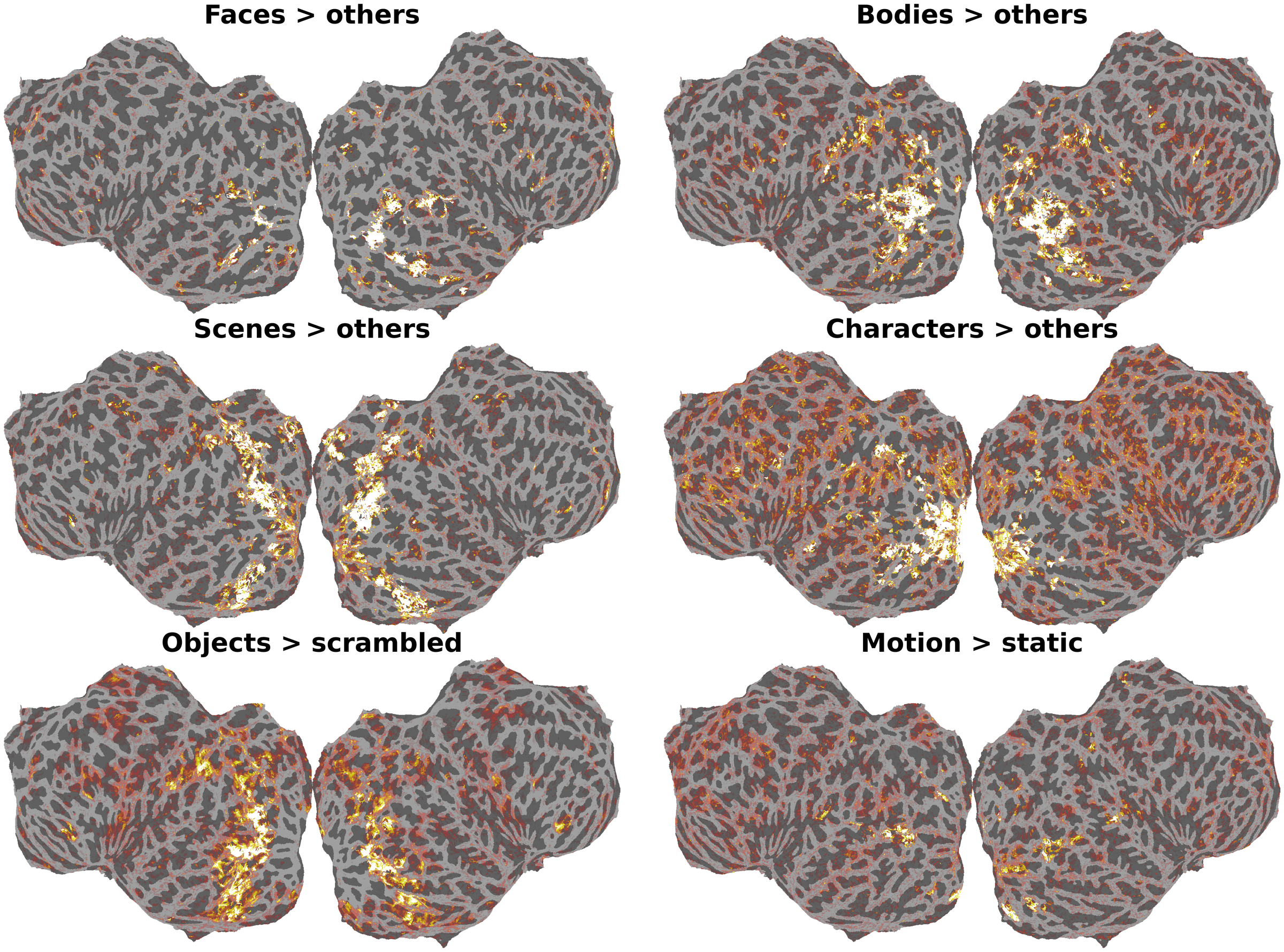
Main localizer contrasts for sub-03, on the flattened left and right hemispheres. The five fLoc contrasts are each category against the mean of the other four. The object localizer is objects against their grid-scrambled counterparts, and the motion localizer is moving against static dots, pooled over both hemifields. Maps are the released z-statistics, combined across runs by fixed effects, shown unthresholded. The same maps with the manually delineated ROIs overlaid are shown in ROIs.
All contrasts are released as unthresholded z-maps, combined across the runs of a localizer as described above. For the category localizer, the main contrast for each of the five categories (faces, bodies, places, objects, characters) is that category against the mean of the other four. Each category is also contrasted against the fixation baseline, and four pairwise contrasts are included: faces, bodies and places each against objects, and characters against faces. The object localizer contrasts intact objects against their grid-scrambled counterparts, and each condition against baseline. The motion localizer contrasts moving against static dots, and each against baseline. These motion contrasts are available pooled over all four runs and separately for stimulation of the left and the right visual hemifield. Alongside the contrasts, the per-run condition estimates are released as effect-size maps, one per condition and run.
Localizer |
Session |
Runs |
Contrasts |
|---|---|---|---|
Category (fLoc) |
ses-4BarScreenfLoc |
8 |
|
Object |
ses-31 |
4 |
|
Motion |
ses-MotionLocBarsSML |
4 |
|
Run counts are per participant. Sub-01 is missing the final fLoc run.
Spaces
Sampling |
Notes |
|---|---|
|
Per-hemisphere surface maps ( |
|
Volumetric, from a GLM fitted on voxels covering cortical ribbon and subcortical and cerebellar regions, provided as one NIfTI per map. Canonical for the volume: this is the grid the GLM was fitted on. |
|
The res-1pt5 volumetric maps resampled trilinearly onto the GLMsingle beta grid (143³, 1.778 mm), so localizer contrasts and single-trial betas share voxel indices. A resampled view of the 1.5 mm product, not a refit. |
Warning
Interpolation is confined to the fitted volume: an output voxel is written only where at least half its interpolation weight comes from voxels the GLM estimated, and is NaN otherwise. So unestimated voxels neither dilute their neighbours nor inflate the coverage.
Downloading and loading
A subject’s localizer derivatives, a few hundred MB, are pulled in full
with the include_localizers flag:
from laion_fmri.download import download

download(subject="sub-03", include_localizers=True)
The derivative path helper handles the session and surface/volume naming:
import nibabel as nib
from laion_fmri.derivatives import localizer_statmap_path

path = localizer_statmap_path(
    "sub-03", task="floc", contrast="faceVsOthers",
    session="4BarScreenfLoc", space="fsnative", hemi="L",
)
z = nib.load(path).agg_data()
For the object localizer pass task="oloc", session="31". For a
volumetric map pass space="T1w" with res="1pt5" or res="1pt8" and
omit hemi.
The per-run condition estimates have their own helper. It takes the
regressor name and the run, and returns the path to that run’s effect-size
map in percent signal change; space, hemi and res work as above:
from laion_fmri.derivatives import localizer_effect_path

path = localizer_effect_path(
    "sub-03", task="floc", condition="face",
    session="4BarScreenfLoc", run=1, hemi="L",
)
Pass task="MotionLeft" or "MotionRight"; the pooled MotionLoc map
has no runs of its own.
File organization
Localizer maps are per-session, so they sit under sub-XX/ses-YY/func/.
contrast- names the contrast in camelCase, stat- the statistic
(z for contrasts, effect for per-run condition estimates).
derivatives/localizers/
└── sub-XX/
    ├── ses-4BarScreenfLoc/
    │   └── func/
    │       ├── sub-XX_ses-4BarScreenfLoc_task-floc_hemi-L_space-fsnative_contrast-faceVsOthers_stat-z_statmap.func.gii
    │       ├── sub-XX_ses-4BarScreenfLoc_task-floc_run-01_hemi-L_space-fsnative_contrast-body_stat-effect_statmap.func.gii
    │       ├── sub-XX_ses-4BarScreenfLoc_task-floc_space-T1w_res-1pt5_contrast-faceVsOthers_stat-z_statmap.nii.gz
    │       ├── sub-XX_ses-4BarScreenfLoc_task-floc_run-01_space-T1w_res-1pt5_contrast-body_stat-effect_statmap.nii.gz
    │       └── sub-XX_ses-4BarScreenfLoc_task-floc_space-T1w_res-1pt8_contrast-faceVsOthers_stat-z_statmap.nii.gz
    ├── ses-MotionLocBarsSML/
    │   └── func/
    │       ├── sub-XX_ses-MotionLocBarsSML_task-MotionLoc_hemi-L_space-fsnative_contrast-movingVsStatic_stat-z_statmap.func.gii
    │       └── sub-XX_ses-MotionLocBarsSML_task-MotionLeft_hemi-L_space-fsnative_contrast-movingVsStatic_stat-z_statmap.func.gii
    └── ses-31/
        └── func/
            └── sub-XX_ses-31_task-oloc_hemi-L_space-fsnative_contrast-objectVsScrambled_stat-z_statmap.func.gii
References
Abraham A, Pedregosa F, Eickenberg M, Gervais P, Mueller A, Kossaifi J, Gramfort A, Thirion B and Varoquaux G (2014) Machine learning for neuroimaging with scikit-learn. Frontiers in Neuroinformatics 8:14. doi:10.3389/fninf.2014.00014
Huk AC, Dougherty RF and Heeger DJ (2002) Retinotopy and functional subdivision of human areas MT and MST. Journal of Neuroscience 22:7195-7205. doi:10.1523/JNEUROSCI.22-16-07195.2002
Malach R, Reppas JB, Benson RR, Kwong KK, Jiang H, Kennedy WA, Ledden PJ, Brady TJ, Rosen BR and Tootell RBH (1995) Object-related activity revealed by functional magnetic resonance imaging in human occipital cortex. PNAS 92:8135-8139. doi:10.1073/pnas.92.18.8135
Stigliani A, Weiner KS and Grill-Spector K (2015) Temporal processing capacity in high-level visual cortex is domain specific. Journal of Neuroscience 35:12412-12424. doi:10.1523/JNEUROSCI.4822-14.2015